
If my desk could talk, it wouldn’t scream.
It wouldn’t apologize either.
It would sigh, sip my coffee, and say: “Relax. I look chaotic, but I know exactly what I’m doing.”
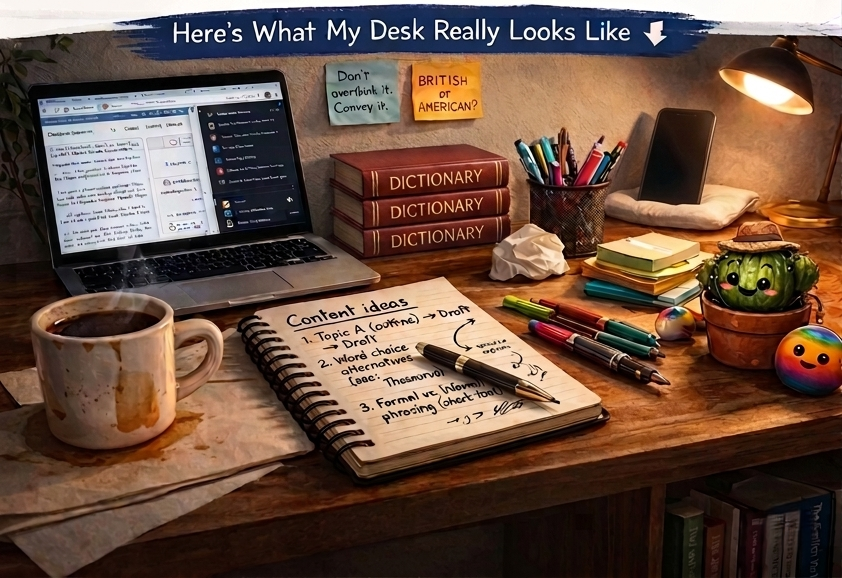
At first glance, my desk gives off mixed signals. It’s not minimalist enough to belong to a productivity influencer, but it’s also not the disaster zone. It lives somewhere in between a carefully negotiated truce between order and chaos. Much like a translator’s brain. Let’s hear what the objects on my desk have to say.
The Laptop: “I Carry Three Languages and One Existential Crisis”
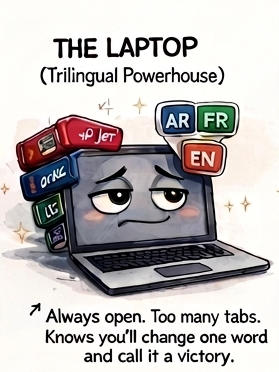
The laptop is the obvious star of the desk. It’s open at all times, even when it shouldn’t be. It hosts at least ten tabs, two dictionaries, one half-written document, and a playlist that claims to improve focus but mostly exists to block out reality.
If it could talk, it would say it’s tired, not from work, but from decisions. British or American spelling? Formal or friendly tone? Is this sentence clear or too clear? Translators don’t just type, they negotiate meaning for a living. The laptop knows this. It has seen me stare at the same sentence for five minutes, only to change one word and feel victorious.
The Notebook: “I’m Where Ideas Come to Hide”
There’s always a notebook. Always.
It’s not neat. It’s not messy either. It’s… hopeful.
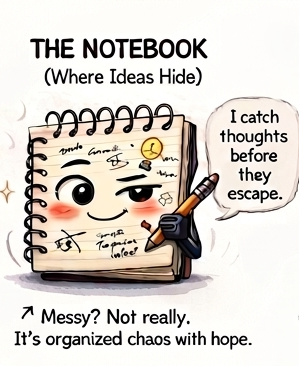
Some pages contain serious notes. Others contain half-sentences, arrows, random thoughts, and words circled aggressively. This notebook isn’t about structure, it’s about catching thoughts before they escape. Translators think fast and forget faster.
If the notebook could speak, it would proudly announce that it holds ideas that never made it into the final text, and ideas that saved the entire project at the last minute.
The Pen Collection: “We’re Decorative, Don’t Ask Questions”
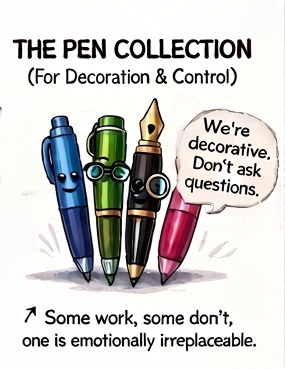
There are more pens than necessary. Some work. Some don’t. One is emotionally important for no reason.
This is not about writing. This is about control. Translators deal with uncertainty all day, so owning multiple pens feels like stability. The pens would definitely gossip about me switching between them mid-sentence, convinced that the right pen will unlock the right phrasing.
It won’t.
But hope is free.
The Coffee Mug: “I Am Not a Beverage, I Am a Lifestyle”
The coffee mug has seen things.
Cold coffee. Reheated coffee. Coffee forgotten until it became a philosophical statement.
It would probably complain about being refilled without being washed and being trusted to carry emotional weight it never asked for. Translators don’t drink coffee for energy, they drink it for comfort, routine, and the illusion of productivity.
If the mug could talk, it would say: “You don’t need more coffee. You need to stop rereading that sentence.”
I would ignore it.

The Phone: “I’m Not Lost, I’m Strategically Distant”
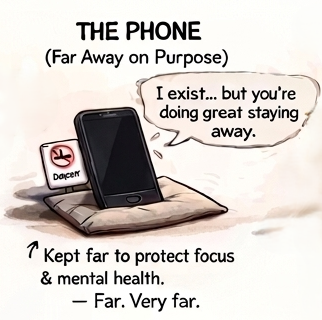
My phone isn’t near me. It knows better. I get distracted way too fast, so I keep it at a safe distance. If it could talk, it would probably say, “You’re welcome, I’m keeping your focus alive.”
The Random Object No One Can Explain
Every desk has one.
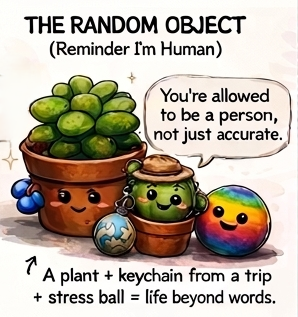
A keychain. A tiny plant. A stress ball. A souvenir from a trip that somehow feels connected to work.
This object represents the translator as a human being, not just a language machine. It reminds me that words come from life, experience, travel, food, conversations, and curiosity. Not just dictionaries.
If it could talk, it would say: “You’re allowed to be a person, not just accurate.”
What My Desk Says About Me
My desk says I like balance.
I need structure, but not too much.
I want things tidy, but not sterile.
I work seriously, but I don’t take myself too seriously.
Like translation, my desk lives in the in-between. Between languages. Between ideas. Between chaos and control. And honestly? That’s where the best work happens. So… what would your desk say about you? Or better yet, which object on it would speak the loudest? I’d love to hear your answers.

I definitely feel called out by the decorative pens.
You asked which object would speak the loudest on my desk? The post-it note that just says « ??? » from last week. It would just stare at me and say: « Are you okay? I still don’t know what that meant… »
This was a lovely read! Also, your coffee mug deserves a raise.
The « ??? » post-it is honestly one of the most powerful objects on any desk.
It somehow captures confusion and still refuses to explain itself.
And yes, the decorative pens are thriving.
Thank you for your comment, I am really glad you enjoyed it!
I love this post Hiba, it captures the quiet chaos of a translator’s mind with such accuracy and wit.
As for me, I would choose… the glass of water. Not because it speaks the loudest, but because it has mastered the art of waiting while I keep telling it, “after this sentence”… which, in translation terms, means never.
At this point, it’s no longer a glass of water. It’s a silent witness to postponed hydration, a symbol of optimism, and possibly the longest-running commitment of my day.
I love this, the glass of water is such an underrated character!
It really does become a quiet witness to all those « just one more sentence » moments that somehow never end. At this point it deserves credit for its patience.
Thank you so much for your comment, I am really glad the post resonated with you!